Choosing the Best CPAP Mask for Side Sleepers

You settle into bed, find a comfortable position on your side, and close your eyes.
Just as you start to drift off, you hear a sharp hiss of air.
You shift your head, but the mask pulls away from your face, and the machine starts to alarm.
By the time you get the seal tight again, you are wide awake and frustrated.
If this happens every night, the problem likely isn’t your sleeping position; it is your equipment.
While many traditional masks were originally designed for back sleepers, side sleeping is actually the most common way to rest. When you sleep on your side, your pillow puts physical pressure on the mask frame. This can shift the cushion and may lead to leaks or pressure marks on your cheeks.
Finding the best CPAP mask for side sleepers involves choosing a design that accounts for this pillow contact.
We want to help you understand which features provide the most stability so you can sleep in your natural position without fighting your equipment.
Why Side Sleeping Challenges Your Mask Seal
To find a solution, we have to look at why masks move when you roll over.
Most standard masks have a rigid frame. When that frame hits a pillow, the pillow pushes the mask out of alignment. This distorts the silicone cushion, creating a gap between the mask and your skin.
Large masks that cover the bridge of your nose are often the most prone to these leaks because they have more surface area for the pillow to “catch.”
This is why many side sleepers notice their sleep reports show higher leak rates than they expected, even if they didn’t consciously wake up.
Design Features That Support Side Sleeping
In our clinical experience, certain design elements are more successful at maintaining a seal for patients who prefer their side.
Top-of-Head Tubing
Traditional masks have a hose that hangs down from the front of the face. When you turn on your side, the weight of that hose can act like a lever, pulling the mask away from your nose.
Several modern designs, such as the DreamWear full face mask, connect the hose at the top of the head. This allows for more freedom of movement and reduces the “drag” on the mask seal.
Low-Profile Frames
The more minimalist a mask is, the less likely it is to be displaced by a pillow.
We often recommend masks that sit under the nose rather than over the bridge. Because there is less bulky material on the bridge of the nose, there is less structure for your pillow to push out of place.
Flexible Materials
Cushions that use adaptive silicone or soft fabric may conform more comfortably to the face for some patients. These materials may compress more easily against a pillow while still supporting a stable seal.
Matching a Mask to Your Breathing Style
The best CPAP mask for side sleepers also depends on how you breathe. We typically group recommendations into three categories based on patient needs.
Nasal Pillow Masks
For many side sleepers, a nasal pillow mask is an excellent starting point.
These use small, soft inserts that sit at the base of the nostrils. Because they have a very small footprint on the face, they have the least amount of contact with your pillow. They are often preferred by people who feel claustrophobic in larger masks.
Nasal Cradle Masks
These masks sit just under the nose, providing a stable seal without the “direct” airflow sensation of nasal pillows.
They offer a low profile that works well for side sleepers who want more stability but do not need a full face mask.
Full Face Masks for Side Sleepers
If you breathe through your mouth, you need a mask that covers both the nose and mouth to prevent air from escaping.
A hybrid model, like the DreamWear full-face mask, is often a good fit here. Because it seals under the nose rather than over the bridge, it keeps the top of the face clear.
This design is intended to reduce the bulk that usually causes leaks when your face is pressed against a pillow.
Improving Your Comfort at Home
Sometimes, small adjustments to your environment can improve your experience with any mask.
- Pillow Choice: A very firm pillow can be difficult for CPAP users. Using a softer pillow or a dedicated CPAP pillow with side cutouts can give the mask frame more room to rest without being pushed.
- Tension Adjustments: When a mask leaks, the instinct is to tighten the straps. This often makes leaks worse by flattening the cushion and causing skin irritation. A mask should rest comfortably on your face, not be crushed against it.
- Hose Management: Simply routing your tubing over your headboard or using a hose lift can reduce the “pull” on your mask when you change positions.
Questions We Hear About CPAP Masks for Side Sleepers
1. Can I use a full face mask if I sleep on my side?
Yes, but choosing the right style is key. Low-profile full-face designs are often easier to use for side sleeping than older, bulkier full-face masks. You can find more details on these styles in our sleep therapy guide.
2. Why does my mask only start leaking halfway through the night?
As you fall into a deeper sleep, your facial muscles relax. A mask that felt secure when you were awake may start to leak as your jaw drops or your cheeks relax.
Additionally, if your machine is set to an auto-adjusting pressure, it may increase air pressure during the night, which can stress the seal more.
H3: 3. Will a smaller mask size help?
Not necessarily. A mask that is too small will pinch your nostrils or rest awkwardly on your lip, which actually makes it more likely to shift. We recommend an in-person fitting to make sure your size is clinically appropriate for your facial structure.
4. Is top-of-head tubing louder for the user?
Many patients find top-of-head designs quieter or less disruptive because the tubing is kept away from the front of the face. For some users, that makes airflow feel less noticeable during the night.
Personalized Care for a Better Night’s Sleep
At CPAP One-Stop, we know that a mask is only effective if it stays comfortable until morning.
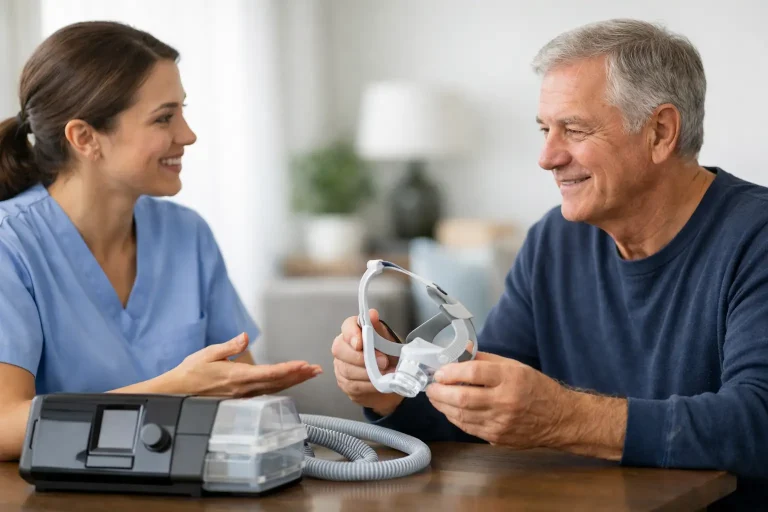
We don’t believe in “one size fits all” solutions. Our clinicians take the time to sit down with you, look at your facial structure, and let you try different options to find what feels right for your specific sleeping habits.
If you are struggling with air leaks or waking up feeling unrested, you don’t have to settle for poor sleep. Whether you need a low-profile side-sleeper mask or expert advice on your current setup, we can help you review your options and make practical changes that improve comfort.
We offer free delivery for supplies and one-on-one support to make sure your comfort comes first.
Ready to find a mask that stays sealed?
Visit us in Niagara or Hamilton to explore options that fit your sleeping style.
Phone: 1-905-246-9590
Email: GMB@CPAPoneSTOP.com
Online: Book an in-person mask fitting
Disclaimer
This blog is for informational purposes only and does not replace professional medical advice, diagnosis, or treatment. Always consult a qualified healthcare provider regarding your specific condition and CPAP therapy. Individual results may vary.