BiPAP vs. CPAP: Understanding the Clinical Differences

You likely left your sleep study appointment with a diagnosis and a new prescription. Obstructive sleep apnea can feel like a lot to take in. Then, somewhere between the clinic and home, you started seeing terms you didn’t expect: CPAP, BiPAP, and APAP.
It’s easy to assume that one of these must be a better version of the others. You might even hear people talk about upgrading to a different device. However, the truth is that there’s no hierarchy here. These machines aren’t different grades of the same thing; they’re distinct tools designed for different medical needs. Understanding the difference between a BiPAP machine vs CPAP or APAP machine is one of the most important steps you can take before starting your therapy.
Let’s look at how these machines work so you can feel confident in the path your doctor has chosen for you.
The Core Difference: BiPAP Machine vs CPAP
Both machines belong to a family called positive airway pressure therapy.
Their goal is to keep your airway open while you sleep by delivering a gentle stream of air through a mask. This prevents pauses in breathing (apneas), which leave you feeling exhausted.
The difference lies entirely in how that air pressure is delivered:
- CPAP (Continuous Positive Airway Pressure): This machine delivers a steady, constant pressure throughout the night. Whether you’re breathing in or out, the pressure remains the same.
- BiPAP (Bilevel Positive Airway Pressure): This device delivers two pressure levels. You get a higher pressure when you inhale and a lower, easier pressure when you exhale.
For most people, CPAP is the gold standard for treating sleep apnea. It’s the most common and effective starting point for obstructive sleep apnea.
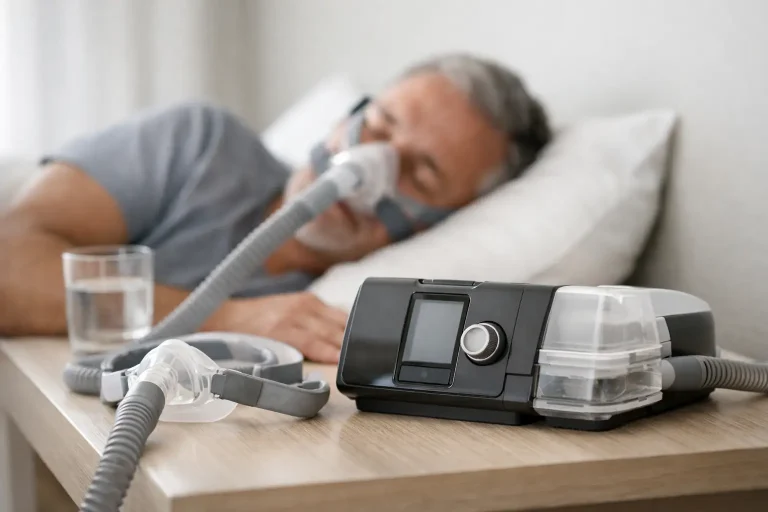
CPAP machines come in a variety of sizes, unlike BiPAP machines. Standard models are designed for home use and are typically about the size of a small shoebox, while travel versions are much more compact and can fit in the palm of your hand.
When BiPAP Is the Right Clinical Choice
A CPAP expert or sleep physician will typically recommend a BiPAP in very specific cases. These aren’t just preferences; they’re based on how your body functions during sleep.
Here are scenarios where you’ll need a BiPAP machine:
Difficulty with High Pressure
Some patients find it difficult to exhale against the continuous pressure of CPAP, especially at higher settings.
This sensation, often described as breathing against resistance, can cause a feeling of air trapping or breathlessness.
If this discomfort prevents you from using your therapy consistently, your physician may trial a bilevel device to see whether the lower expiratory pressure improves adherence.
Central Sleep Apnea
In some cases, the brain briefly forgets to tell the body to breathe. This is called central sleep apnea.
Because there is no physical blockage, a standard CPAP often isn’t enough. Advanced BiPAP machines can prompt a breath if they sense you haven’t taken one.
Respiratory Conditions
Patients with chronic obstructive pulmonary disease (COPD), obesity hypoventilation syndrome, or neuromuscular diseases that weaken breathing muscles may require bilevel therapy not only to keep the airway open but to actively assist ventilation.
In these cases, BiPAP helps move air into and out of the lungs, not just hold the airway open.
Troubleshooting Your Sleep Apnea Treatment
It’s a common myth that if you find CPAP uncomfortable, you just need a BiPAP. In reality, most discomfort comes from things a different machine won’t fix.
Issues like a leaky CPAP mask, incorrect humidity, or a dry nose are the usual culprits. If your mask doesn’t fit right, you’ll likely have the same problem with a BiPAP.
Before assuming you need a different therapy type, it’s worth chatting with a CPAP expert to optimize your current setup.
Small adjustments, such as changing your mask style or using a heated tube, often make a world of difference. Most patients find that once these details are sorted, their original therapy becomes perfectly comfortable.
Call CPAP One-Stop Today with any Questions….
…. We Love to Talk! 905-246-9590
Frequently Asked Questions
Can I buy a BiPAP if I have a CPAP prescription?
No. Because BiPAP is a different type of medical therapy, it requires a specific prescription from your doctor. A CPAP expert cannot swap one for the other without medical authorization.
Is BiPAP therapy more expensive?
Yes. BiPAP machines are more complex and generally cost more than standard CPAP. However, if it’s medically necessary, provincial programs such as Ontario’s Assisted Devices Program (ADP) may help cover the costs.
Will BiPAP help me sleep more comfortably than CPAP?
Not necessarily. Comfort depends on many factors, including mask fit, humidity levels, and pressure settings.
Some patients do find the lower exhalation pressure of BiPAP easier to tolerate, but this doesn’t mean everyone will.
If CPAP feels uncomfortable, the first step is to troubleshoot your current setup rather than assume you need a different machine.
How do I know if my pressure is set correctly?
If you still feel tired, wake up gasping, or see high apnea-hypopnea index (AHI) numbers on your machine’s display, your pressure might need adjustment.
Always consult your doctor or sleep apnea treatment expert before making changes to these settings.
Is it hard to get used to the two pressures of BiPAP?
Most people find the transition to BiPAP quite natural because it mimics the way we breathe. Your therapist will walk you through the sensation during your setup.
CPAP and BiPAP Support in Niagara and Hamilton: Find the Right Therapy for You
The choice between a BiPAP machine and a CPAP isn’t about which is better. It’s about which one is right for you. CPAP is an incredible, effective tool for most people, while BiPAP provides essential support for those with more complex needs.
If you’re starting your sleep apnea treatment, don’t feel like you’re missing out if you weren’t prescribed a BiPAP. Focus on finding a mask that feels good and building a consistent nightly habit.
If you have questions about your prescription or want to see the equipment in person, the team at CPAP One-Stop is ready to help.
Our clinics across Niagara and Hamilton offer a supportive space to learn about your therapy. You can book a consultation today to get the answers you need to start sleeping better.