Best CPAP Machines Beginners Can Actually Use
The best CPAP machines for beginners are not necessarily the most expensive or the most feature-packed. They are the machines you can sleep with consistently: quiet enough for your bedroom, simple enough to operate when you are tired, and supported by a proper mask fitting and pressure setup. A machine is only a good choice if it helps you use therapy night after night.
For most people newly diagnosed with obstructive sleep apnea, an auto-adjusting CPAP machine, also called APAP, is the strongest starting point. It can adjust pressure within a range prescribed by your clinician as your breathing needs change through the night. But the machine itself is only part of the decision. Comfort settings, humidification, mask compatibility, insurance coverage, and real human support all affect whether treatment feels manageable or frustrating.
What Beginners Should Look for First
A first CPAP machine should reduce the number of things you have to worry about. Look for an easy display, a built-in humidifier, clear cleaning instructions, and data tracking that your provider can review. You should also be able to use a heated tube if you struggle with dry mouth, nasal dryness, or rainout, which is condensation that can collect in the tubing.
Noise matters, but modern CPAP machines are generally quiet. What many people interpret as machine noise is actually air leaking from a poorly fitted mask. Before paying extra for a specific model, make sure you can receive a proper mask fitting and follow-up help. A comfortable mask can make a bigger difference than a minor difference in sound ratings.
You should also ask whether setup, programming, and follow-up data downloads are included. Do not assume they are. Some suppliers advertise a low machine price, then add charges for setup, instruction, or accessories that are essential to starting therapy. Ask for the complete price before you commit.
Best CPAP Machines for Beginners: Start With APAP
ResMed AirSense 11 AutoSet
The ResMed AirSense 11 AutoSet is a common choice for first-time users because it combines automatic pressure adjustment with a simple touchscreen, built-in humidification, and guided setup features. It is designed to make the first few nights less intimidating, which matters when you are learning how to sleep with a mask and tubing.
Its automatic pressure response can be helpful if your prescribed needs vary by sleep position, stage of sleep, congestion, or alcohol use. It also provides therapy data that a clinician can review when something feels off. If you wake up feeling bloated, dry, or still tired, those details help identify whether the issue is pressure, mask leak, humidity, or usage time.
The trade-off is cost. The AirSense 11 is often priced at the higher end of standard APAP options. It may be worth it if you want a current model with strong data support and a straightforward user experience, but it is not the only effective choice.
ResMed AirSense 10 AutoSet
The ResMed AirSense 10 AutoSet remains a dependable option when available. It has a proven track record, intuitive controls, humidification, and automatic pressure adjustment. Many experienced CPAP users prefer it because it is familiar, durable, and uncomplicated.
For beginners, the main advantage is that it delivers the features that matter without making the nightly routine feel complicated. Depending on inventory and coverage, it can also be a better value than a newer model. If you do not care about a touchscreen or app-focused features, this may be all the machine you need.
Luna G3 Auto CPAP
The Luna G3 Auto CPAP is another practical APAP option for new users. It offers auto-adjusting pressure, humidification, therapy reporting, and a user-friendly interface. It can be a sensible fit for someone who wants reliable therapy and comfort features while keeping an eye on total cost.
As with any machine, the important question is not whether it has the longest feature list. Ask whether your clinician can program it correctly, access the data when needed, and help you resolve comfort issues. A less familiar machine with excellent local support can be a better choice than a popular model purchased with no help afterward.
Fisher & Paykel SleepStyle Auto
Fisher & Paykel’s SleepStyle Auto is known for comfort-focused design and easy daily use. Its humidification system and straightforward controls appeal to users who are concerned about dryness or who want fewer complicated settings to manage.
This can be a strong option if comfort is your top priority, especially if you have already dealt with dry nose, dry throat, or frequent congestion. Availability, insurance rules, and your prescribed therapy needs may affect whether it is the right fit, so treat it as a machine to compare rather than a universal answer.
Fixed CPAP, APAP, and BiPAP Are Not the Same
A fixed-pressure CPAP delivers one prescribed pressure all night. It can be effective, affordable, and easy to use when your clinician has determined that a single pressure is appropriate. Some beginners do very well with fixed CPAP, especially when they prefer a simple, consistent experience.
APAP adjusts within a prescribed range. For many new users, that flexibility can improve comfort because the machine does not stay at a higher pressure when it is not needed. Still, APAP is not automatically better for every diagnosis or every prescription.
BiPAP, sometimes called bilevel therapy, provides different pressures for inhaling and exhaling. It is usually considered when standard CPAP or APAP is not tolerated, when pressure requirements are high, or when certain breathing conditions call for it. Do not buy a BiPAP simply because it sounds more advanced. It requires the right prescription and clinical guidance.
The Comfort Features That Make a Real Difference
Pressure relief is one feature worth asking about. It slightly lowers pressure when you breathe out, which can make therapy feel more natural for people who initially feel they are pushing against the air. Ramp settings are also helpful. They begin at a lower pressure and gradually increase as you fall asleep.
Humidification deserves just as much attention. If your mouth or nose feels dry, you may need a humidity adjustment, a heated tube, or a better mask seal. Do not stop therapy after a few uncomfortable nights without getting help. Most early comfort problems can be corrected.
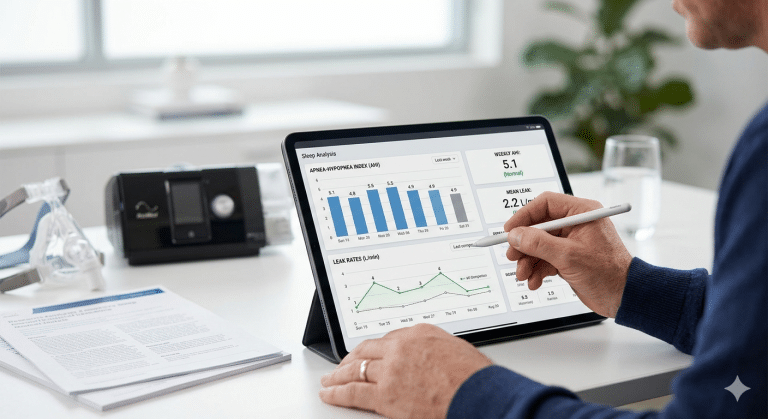
A good beginner machine should also provide usable data. You do not need to become your own sleep technician, but your care team should be able to see usage time, leak levels, and treatment results. That information turns vague complaints like “I hate this thing” into specific solutions.
Your Mask May Matter More Than Your Machine
There is no single best mask for every beginner. Nasal masks cover the nose. Nasal pillow masks sit at the nostrils and are often less bulky. Full-face masks cover the nose and mouth and can be useful for people who breathe through their mouth or have frequent nasal congestion.
The best mask is the one that seals without being painfully tight. Overtightening often makes leaks worse and leaves facial marks. If you are waking up with air blowing toward your eyes, dry mouth, or sore skin, ask for a refit rather than assuming CPAP is not for you.
This is where face-to-face support is worth protecting. A clinician can watch how the mask fits when you lie down, adjust the headgear, and help you test another style when the first choice is not working. At CPAP One-Stop, that kind of hands-on setup is part of making therapy personal, not an extra you should be surprised to pay for later.
Questions to Ask Before You Buy
Before choosing a machine, get clear answers about the full cost, your insurance billing, included setup, warranty support, and what happens if the mask does not fit. Ask whether you will receive help with machine programming and data review after the first week or month. Those services are especially valuable when you are new to therapy.
Also ask what is included in the package. A machine may require separate items such as a mask, tubing, filters, humidifier chamber, heated tube, and travel bag. Buying only the lowest advertised machine price can leave you with unexpected costs before you even use it.
The right first CPAP machine should feel like a practical tool, not another medical problem to manage. Choose the model that fits your prescription, budget, and comfort needs, then give yourself the support to use it properly. Better sleep often starts with one ordinary night when the mask fits, the pressure feels right, and you finally wake up feeling like yourself again.