Is a ResMed AirMini Travel CPAP Machine Worth the Second Investment?

You’re packing for a trip. Maybe it’s a weekend at the cottage, a flight to visit family, or a work conference. Then you look at your CPAP machine and realize how much space it takes.
This is the moment when many people first wonder about portable options. The ResMed AirMini travel CPAP machine often comes up in searches and conversations with other patients. It is small, light, and looks like total freedom.
But here is the question that rarely gets a straight answer: Do you need a second machine?
While the industry may push extra equipment, the goal is to find what fits your lifestyle. At CPAP One-Stop, we help you choose based on your real needs, not just what’s new or popular.
This guide looks at the real differences between travel units and standard home machines, the trade-offs involved, and when a second machine genuinely helps.
What Makes a ResMed AirMini Travel CPAP Different?
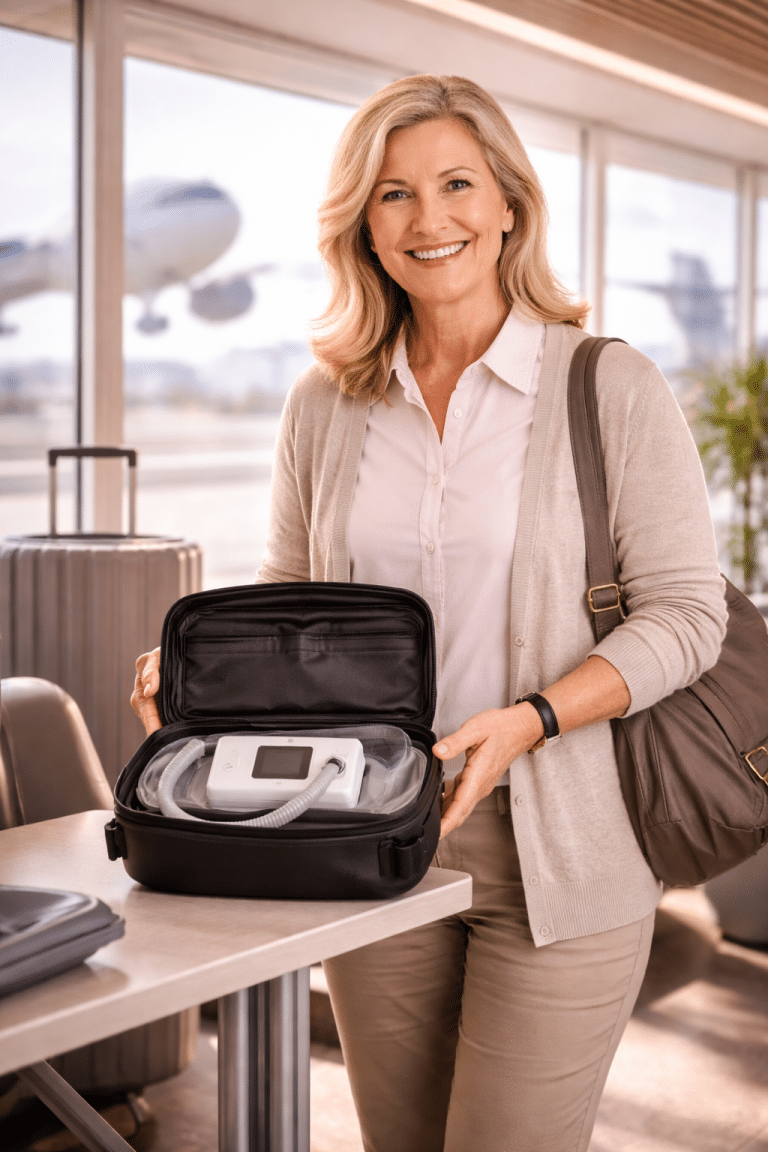
The ResMed AirMini is a popular choice for a reason. It weighs about 300 grams, roughly the weight of a can of soup, and fits in a bag smaller than a lunch box.
For anyone tired of hauling a full-size unit, it feels like a revelation. However, compact size requires some trade-offs.
Size and Portability
The most obvious difference is physical. A standard machine like the ResMed AirSense 11 weighs around 1.1 kilograms and takes up significant space. For air travel, the ResMed AirMini travel CPAP is a clear winner.
Please note that most airlines don’t count medical devices toward your carry-on limit, regardless of whether they’re travel-sized or standard.
Power and Battery Compatibility
Travel often involves unpredictable power. The ResMed AirMini travel CPAP offers excellent battery compatibility through external packs.
This is a lifesaver for camping or long international flights where you might not have an outlet nearby. While home machines can run on batteries, the setup is often much bulkier and requires specific adapters.
Noise Levels
Modern machines are quiet, usually operating at about 30 decibels (like a whisper).
While travel machines are very quiet, the smaller motors sometimes have a slightly different pitch than home units. Most people find the difference minor, but it’s something to keep in mind if you’re a very light sleeper.
The Humidification Trade-Off
This is where things get more complicated. Most people rely on heated humidification to keep their airways comfortable and prevent a dry, sore throat.
Standard machines have a built-in water chamber that creates warm mist. The ResMed AirMini travel CPAP machine, however, uses a waterless system called HumidX. This small disc captures moisture from your breath and returns it to you.
According to sleepapnea.org, humidification is vital for many users to stick with their therapy.
If you have very high humidity needs or live in a desert climate, the waterless system might feel different. It works well for most, but it’s a trade-off for the sake of size.
So, Do You Need Both CPAP Machines?
Many believe that serious travellers must own two machines. That isn’t always the case.
When One Machine Is Enough
Here are the scenarios where a travel CPAP is less necessary than it seems:
- You travel once or twice a year: For occasional trips, the inconvenience of a standard machine is minor. You pack it, you use it, you come home. The cost of a second device may not justify the handful of times you’d benefit from it.
- You’re comfortable with your current setup: If your home CPAP travels reasonably well and you’ve never had issues using it on the road, you may be solving a problem you don’t actually have.
- You rely heavily on heated humidification: If dry air causes you real discomfort, switching to a waterless travel system may make your trips harder, not easier. The smaller machine won’t feel like a convenience if it leaves you waking up with a raw throat.
When a Travel CPAP Genuinely Helps
A dedicated travel unit makes sense if:
- You travel frequently for work: If you’re on the road multiple times a month, the cumulative hassle of packing and unpacking a full-sized unit adds up. A dedicated travel machine simplifies your routine.
- You camp, hike, or spend time off-grid: Battery-powered travel units are designed for environments where standard machines struggle. If outdoor adventures are a regular part of your life, a travel CPAP extends your therapy options.
- Travelling with your home machine causes you to skip therapy: Some people skip nights or use their CPAP inconsistently when travelling because the setup feels like too much effort.
- You want a backup: Equipment fails sometimes. Having a second machine means a motor issue or a leak at 2 a.m. doesn’t derail your therapy while you wait for repairs or a replacement.
Frequently Asked Questions
Is the therapy from the ResMed AirMini travel CPAP as effective?
Yes. The ResMed AirMini travel CPAP machine uses the same clinical algorithms as the larger ResMed machines.
Your apnea events will be treated with the same precision; the only differences are the device’s physical size and the type of humidification used.
Can I use my regular CPAP machine on an airplane?
Yes. CPAP machines are medical devices, and airlines allow them as carry-on items that don’t count toward your luggage limit.
You can also use them during the flight if you notify the airline in advance and your seat has power access. The main challenge is size and weight, where travel units offer an advantage.
Do travel machines require special masks?
The ResMed AirMini does require specific mask setups to work with its HumidX system. If you already use a ResMed mask, you might only need a specific connector, but it is important to check compatibility before you head out on your trip.
Are travel CPAPs louder than home machines?
Because the motor is smaller, you might hear a bit more “inhale/exhale” sound through the tube. Most users get used to this very quickly, but using a muffler accessory can help if you’re sensitive to sound.
CPAP Travel Support and Free Home Visits in Niagara and Hamilton
If you’re unsure which option fits your needs, getting expert guidance can save you time and money. At CPAP One-Stop, we help you compare travel and home machines, understand the trade-offs, and choose equipment that works for your real routine.
We also offer free home visits across Niagara, Hamilton, and surrounding areas, making it easier for you to get personalized support without needing to travel.
If you’re considering a second machine or want help finding the right setup, call us at 1-905-246-9590 to speak with a specialist.
With the right equipment and support, you can travel confidently while staying consistent with your therapy.