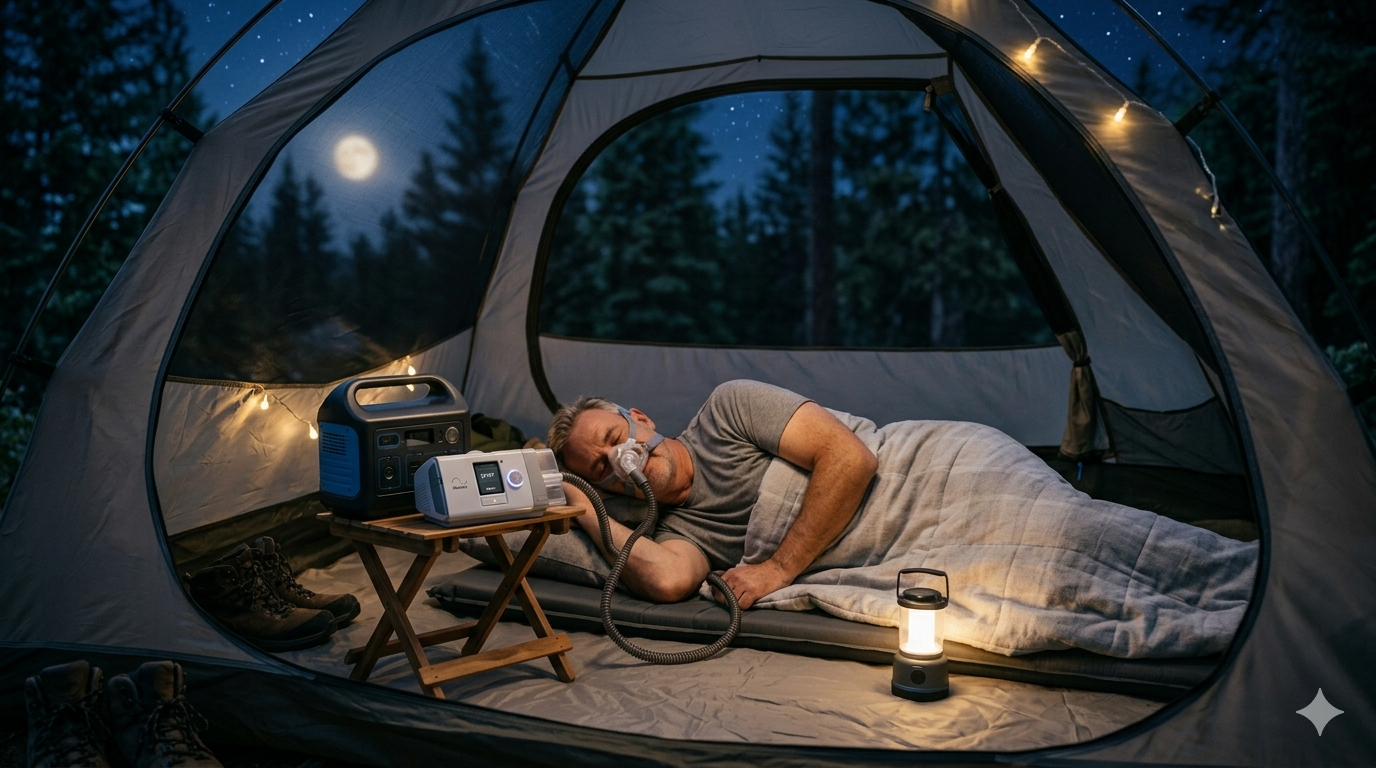
You finally booked that perfect campsite. Perhaps it’s a quiet spot on Georgian Bay, a provincial park in Algonquin, or a Backcountry site only reachable only by canoe.
After sorting your gear and planning your meals, a familiar question may come to mind: how will you power your CPAP?
In fact, many patients ask providers like CPAP One-Stop about this when preparing for outdoor trips where electrical outlets are not available.
After all, sleep apnea doesn’t take a vacation. Your body still needs consistent air pressure through the night, whether you’re sleeping in your bedroom or in a tent beside a lake.
However, enjoying the outdoors often means leaving behind the power sources that normally make therapy simple.
Fortunately, choosing a CPAP battery for camping no longer means hauling heavy equipment or worrying about your machine shutting off in the middle of the night.
Why Standard Power Banks Fall Short
Before looking at batteries, it helps to understand why a standard phone charger won’t work. Your phone uses very little energy, while a CPAP machine requires a constant, high-power flow.
The exact amount of power your CPAP mask needs depends on your settings. If you use a heated humidifier or heated tubing, your machine draws significantly more energy.
A small power bank that keeps a phone alive for a week might not last an hour running a CPAP.
Calculate Your Portable CPAP Power Requirements
The most common mistake is buying a battery based on a generic “lasts two nights” claim.
To find the right fit, you need to do a little math based on your specific CPAP machine.
Battery capacity is measured in watt-hours (WH). To estimate your runtime, you need to know your machine’s average draw:
- Basic CPAP (No Humidifier): Typically uses 30 to 60 watts.
- With Heated Humidifier: This jumps to 50 to 70 watts.
- With Heated Tubing: This can reach 90 watts or more.
Factors like cold weather can also reduce battery efficiency, so it’s always wise to have a bit of extra buffer in your capacity.
For those managing complex health needs, Health Canada notes that maintaining therapy is vital for preventing daytime fatigue and long-term cardiovascular strain.
Understanding Your CPAP Battery Options
Once you know your numbers, you can look at the different types of power sources available.
Manufacturer-Specific Battery Packs
Brands like ResMed offer power stations built specifically for their devices. These offer peace of mind because they’re guaranteed to be compatible.
Dedicated CPAP Battery Units
Units from companies like Medistrom or Freedom are designed specifically for sleep therapy. They’re lightweight and usually come with the correct cables and adapters to fit various brands. These are excellent for Backcountry camping, where every kilogram matters.
Portable Power Stations
Brands like Jackery or EcoFlow offer large, multi-purpose batteries. These are great for car camping because they can charge your CPAP, your phone, and even a small light.
If you go this route, ensure the unit provides pure sine-wave output to protect your machine’s electronics.
What Most People Get Wrong About Camping with CPAP
There are a few myths that can make camping feel more difficult than it needs to be:
1. You must use your humidifier.
In reality, turning off your heated humidifier can nearly double your battery life. In the humid air of an Ontario summer, many patients find they can sleep comfortably for a few nights without it.
2. The biggest battery is always best.
A massive battery offers peace of mind, but it is heavy. If you’re portaging, a smaller, lightweight battery paired with a properly fitted mask is often a better choice.
3. Cold weather doesn’t matter.
Cold temperatures drain lithium batteries faster. If you’re camping in the spring or fall, keep your battery inside your sleeping bag or wrapped in a blanket to keep it warm and functional.
Practical Tips for Your Trip
- Test it at home: Run your CPAP on the battery for one full night in your bedroom before you head to the campsite.
- Check your settings: Lowering your pressure slightly (only if approved by your doctor) or turning off heated features can save a lot of energy.
- Keep it dry: Moisture is the enemy of electronics. Keep your battery off the ground and inside your tent.
- Bring backups: Always carry your standard AC wall plug. You never know when you might find a site with a working outlet.
FAQs About CPAP Battery for Camping
Will airlines let me fly with a CPAP battery?
Yes, but there are rules. Most lithium batteries under 100Wh are allowed. Between 100 WH and 160 WH, you usually need airline approval. Never put a lithium battery in checked luggage; always keep it in your carry-on.
Can I charge my battery with a solar panel?
Yes, many portable power stations support solar charging. However, charging is slow. A 100-watt solar panel may take a full day of direct sunlight to recharge your battery, so it’s best used as a backup.
How do I know when my battery is getting low?
Most dedicated CPAP batteries have an LED display showing the remaining percentage. It’s a good habit to check this every morning so you can plan for a recharge if needed.
Don’t Let Sleep Apnea Stop Your Adventure
The outdoors should be accessible to everyone. While the power constraint is real, it’s a problem, we can solve together. By matching your battery to your machine’s needs, you can enjoy the stars and wake up feeling refreshed.
If you’re unsure which battery fits your machine or how to adjust your settings for travel, we’re here to help. At CPAP One-Stop, we focus on your success with therapy wherever you are.
Visit a CPAP One location or book a consultation to talk through your travel and camping options.


Leave a Reply